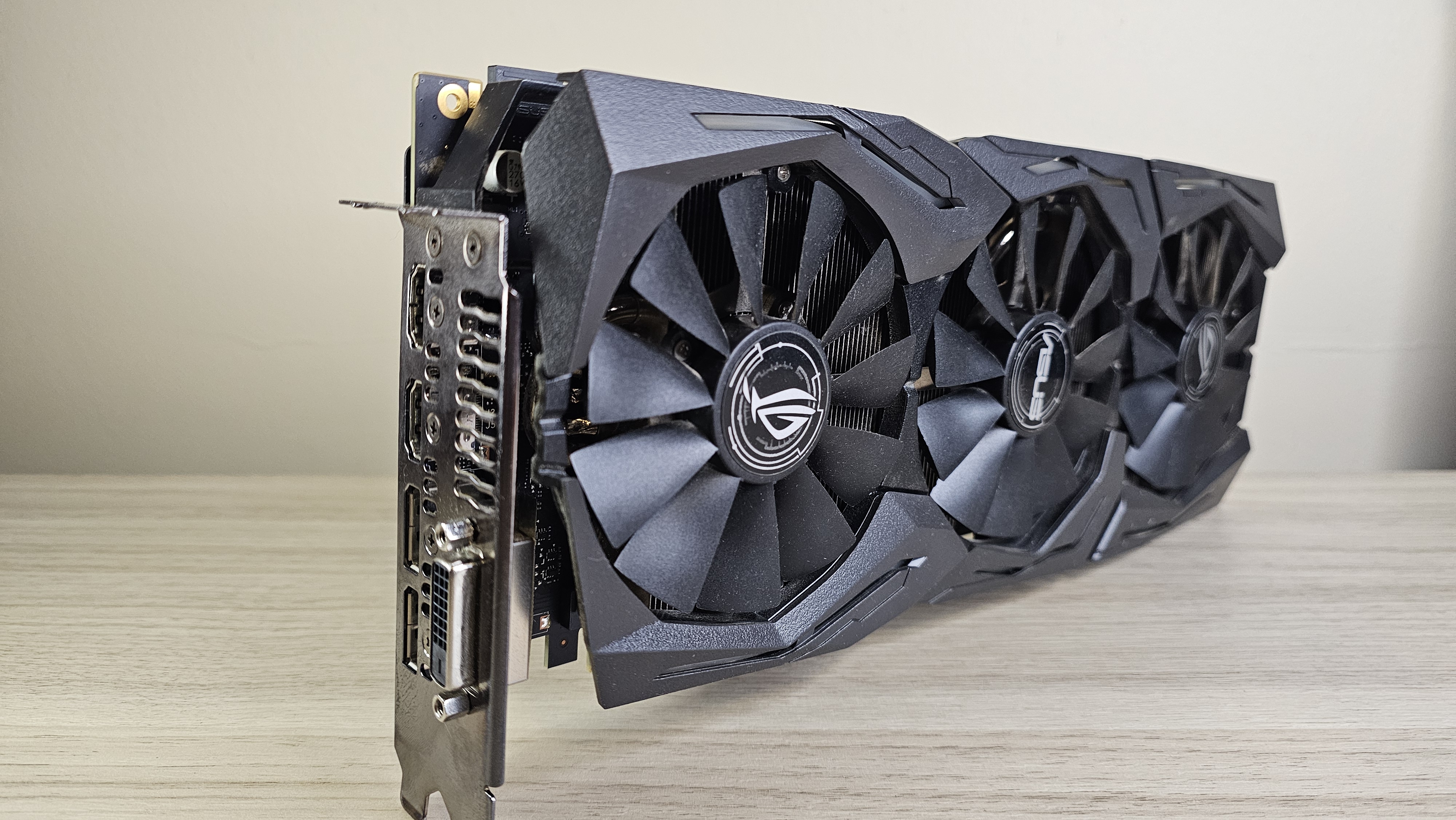
The GTX 1080 Ti 11GB is a legendary GPU that will be remembered for years to come. It showed us that in some cases, age doesn’t matter. Because despite being about 9 years old, it still puts up a fight in modern games…sometimes.
In this article we’ll be benchmarking the GTX 1080 Ti across 10 modern titles at 1080p, 1440p, and (for fun) 4k, with notes on where it still shines, where it struggles, and what compromises you’ll need to make going into 2026.
Prefer video? Watch the full benchmark here: https://youtu.be/d9mc1KkGKFA
TL;DR Verdict
- Buy if: you can find one under $175 USD and you mainly play 1080p high or 1440p low.
- Skip if: You want modern features (DLSS 3, Frame Gen), a warranty, or you mostly play the newest heavy single-player games at high settings or 4k.
Jump to: Test Bench · 1080p · 1440p · 4K · Full Results · Value · Notes
Test Bench
- GPU: ASUS ROG Strix GTX 1080 Ti (stock)
- CPU: AMD Ryzen 9800X3D
- RAM: 64GB DDR5-6000
- Storage: 2TB WD SN850X
- Tools: MSI Afterburner + OBS (light recording settings)
- Notes: Recording reduced FPS slightly in some games — expect ~2–5% higher performance when not recording.
GTX 1080 Ti – 1080p Performance
The 1080 Ti is a monster at 1080p, proving no problem in the games we tested today. It performs especially well in competitive titles like Apex Legends and Delta Force, pushing far above 100 FPS even with high graphics. More recent/demanding games like Battlefield 6 and Marvel Rivals are playable, but clearly benefit from lower settings if you want a smooth experience.
1080P Highlights
- Apex Legends (High): 189 Avg, 124 1% Low – Competitive-ready!
- Battlefield 6 (High): 69 Avg, 51 1% Low – Lower settings for smoother play
- Marvel Rivals (Low): 71 Avg, 58 1% Low – Playable, but upscaling recommended

GTX 1080 Ti – 1440p Performance
We did most of our benchmarking in 1440p because that’s the resolution I would prefer if I used a GTX 1080 Ti. Most of the games didn’t hit 60 fps, but some like Plague Tale Requiem and Helldivers 2 could have the graphics dropped, or you could introduce some minor upscaling to maintain a solid 60. Either way, we can still see good results in the FPS games Apex Legends, Delta Force, and BF6, all performing fairly well for using high graphics.
1440P Highlights
- Apex Legends (High): 130 Avg, 99 1% Low – Competitive-ready!
- Helldivers 2 (High): 50 Avg, 43 1% Low – Good 1% lows, lower settings for smoother
- A Plague Tale Requiem (High): 47 Avg, 35 1% Low – Borderline without upscaling

GTX 1080 Ti – 4k Performance
4k is where we’re clearly pushing the limit of what the GTX 1080 Ti can do. In most modern single-player games, even low settings won’t be enough to get a smooth experience, so 4k is basically off the table unless you’re willing to make some massive compromises to image quality. That said, there are a couple surprises here, namely Arc Raiders at 4K low actually averaged around 60 fps, which shows how much developer optimization can matter. But heavier titles like Cyberpunk 2077 are stuck in the low 20s at native 4k.
4K Highlights
- Arc Raiders (Low): 60 Avg, 44 1% Low – Surprisingly playable, well optimized for older hardware
- Clair Obscur: Expedition 33 (Low, XeSS Perf): 45 Avg, 29 1% Low – Very demanding, not recommended
- Cyberpunk 2077 (Low): 23 Avg, 19 1% Low – Unplayable, upscaling recommended

Full Results
Table coming next: all games + settings + 1080p/1440p/4k results
Value in 2026
Right now you can find a used 1080 Ti on Ebay for like $175 USD, sometimes even less if you’re patient or get lucky with local listings. For that price, you’re getting a GPU that can still handle 1080P High, 1440p Medium, and even some 4K gaming with compromises
If you compare that to something brand new, like a mid range card that costs two to three times more, the performance often isn’t nearly as dramatic as the price jump. Yes, newer GPU’s get you things like better power efficiency, newer technology (DLSS, Ray Tracing), and a warranty; but if your goal is to simply play games smoothly without breaking the bank, the 1080 Ti still delivers.
My Experience Testing the GTX 1080 Ti
This was my first graphics card to test in my GPU benchmarking journey and it presented a few concerns. Nothing overly complicated, but some things worth noting for sure.
You always hear about driver problems/conflicts or the need for DDU when it comes to switching between NVIDIA and AMD. I was pretty worried about this to be honest. But it couldn’t have been easier, I just removed my AMD GPU, installed the 1080 TI, booted up the PC, installed the latest NVIDIA drivers, and done! No need to remove previous drivers or utilize DDU; it seems like that is suggested online often if you ever encounter any problem. But luckily in my case it was smooth! I’ve tested many GPU’s since then and I’ve never had to uninstall the old drivers or use DDU.
It was also very humbling using the 1080 Ti as my high end gaming PC uses an AMD RX 7900 XT, nearly 2.5x stronger. I am used to playing on my 4k 240hz monitor, so it was nice to enjoy gaming at 1080p/1440p again. It really goes to show that you don’t need to spend $3000+ on a PC like mine, you would be able to play the same games on a <$1000 gaming PC.
Alternatives
As mentioned previously, the GTX 1080 Ti can often be found on Ebay for less than $175 USD. If that is priced too high, I’d consider checking out some of the following options and prices I found locally and on Ebay.
- RTX 2070: $145-175 USD
- Approximately 10% weaker
- PRO: Support for DLSS/Ray Tracing
- CON: 8gb VRAM (compared to 1080 Ti 11gb)
- RX 5700 XT: $110-150 USD
- Approximately 10% weaker
- PRO: Great price to performance
- CON: Harder to find
- GTX 1660 Super: $80-100 USD
- Approximately 40% weaker
- PRO: Easier to find (I bought 5 in the past between 100-150 CAD)
- CON: 6gb VRAM (compared to 1080 Ti 11gb)
Notes
- Driver Version: 581.8
- Issues/Conflicts: None experienced
- Recording Note: Expect 2-5% performance difference due to recording strain on GPU
- (I need a good capture card!)
Conclusion
The 1080 Ti is truly one of the best GPU’s ever launched, proving it can still get play AAA games even 9 years after launch. Being released for $699 USD is something i’m sure we will never see again for the best gaming graphics cards (The RTX 5080 MSRP is $999 USD!). It was released at a great value, and even today in 2026 it is one of the best price to performance GPU’s you can find on the market.
also read: About UsernamedTV
Leave a Reply